Showing posts with label Poetry. Show all posts

13 January 2020

The Datsuns - Poetry Noise Abatement Notice

Back in 1999 I used to have a regular meeting with Kai Jensen where we'd discuss poetry and our latest efforts. One day Kai ask if I'd stand in for him at an event as he had to be somewhere else. I agreed but was slightly wary of the circumstances. Apparently the local Waikato University had organised a concert from a 'heavy rock' band that was just getting established. It was to be filmed and broadcast on the University TV channel. My role was to recite poetry between the band's items - and here is the bit -  I was to do the recitations naked in an outside bath.  There was no way I was going to sit naked in a bath with heaps of drunk students and wild musicians - at least shorts were going to be worn. The band was called "The Datsuns".

The Datsuns (photographer unknown - stolen from Wikepedia Website)

So the day arrived and with some trepidation I turned up at the venue a large suburban house used as a student flat. Rain was imminent and the TV crew said the concert would have to be held inside - their gear was too valuable to expose to the rain. The bath couldn't be brought inside so that let me off the hook. The band arrived, set up their gear and then drove off. They arrived back and set to work. I was amazed at the intensity of their music. Students crawled out on hands and knees to offer the lead guitarist their backs as a footstool. I was wondering what everyone was on! I did my bit here and there between items. It was all good fun.

Then the noise police arrived. Even though it was a weekend afternoon the neighbours had had enough. It was near the end of the concert so the band packed their gear and took off.  Normal occurrence they said. The last I heard, they had toured Australia and UK - without me! They left me being issued with the noise infringement notice. It said we must stop the noise and if not we could be taken to court and fined up to $10 000. I hoped the students would not keep up a noise after I left. As I left I saw the neighbours skulking in the shrubbery. I think Catherine could hear the noise at our place.

I have a feeling that I was the first (if not the only) non-musical poet in NZ (the world?) to be issued with a noise abatement notice. My claim to fame!

Here is one of the poems I recited - it had been for unit I'd done at the time as a task for an MA at Waikato Uni.

Agememnon on the Eve of Battle

The airmail edition
of the Paris Tribune
thumps onto the wall
of Agamemnon’s tent.
On its front page
a photo of tomorrow’s victor.
The time warp machine
malfunctioning again,
news coming in
before it has happened.

Just not good enough.
He consults the Penguin
Dictionary of Historical Slang
before saying “beep”-
the remaining papers
will need rounding up
and the image of Achilles
excised before the troops
see it in the latrines
tomorrow morning;
best not to have him
too confident on the eve
of the showdown.
Can’t have the wrong man
dragged about town
by a wild horse.

Just then he hears the click
of Xtra signing in
he sighs when he reads
Sender: Bill Manhire
Subject: Hector
bugger this poet-laureate
with his free wine
and making himself at home
up on the hill with Andromache.
Drinking Cab Sav again,
he guesses.


It was making him suspect
his agent’s credentials;
everyone knew this was not
an Icelandic saga,
despite a retreating icesheet
and the scarcity of mammoths,
and what about this visionary
intelligence …

     “… a wooden horse
up to its hocks in a high tide
outside some city gates
men who descend a ladder
into waves of tears,
all for a Trojan woman.”

Well, the last line made sense,
the only sense
from a poem-quoting seer.

Why don’t his E-mails
mean anything any more?

Agamemnon’s sword hand
grabs the mouse
the cursor hovers over
the delete button…

01 November 2014

Printmakers Print Exchange - WSA - Hamilton

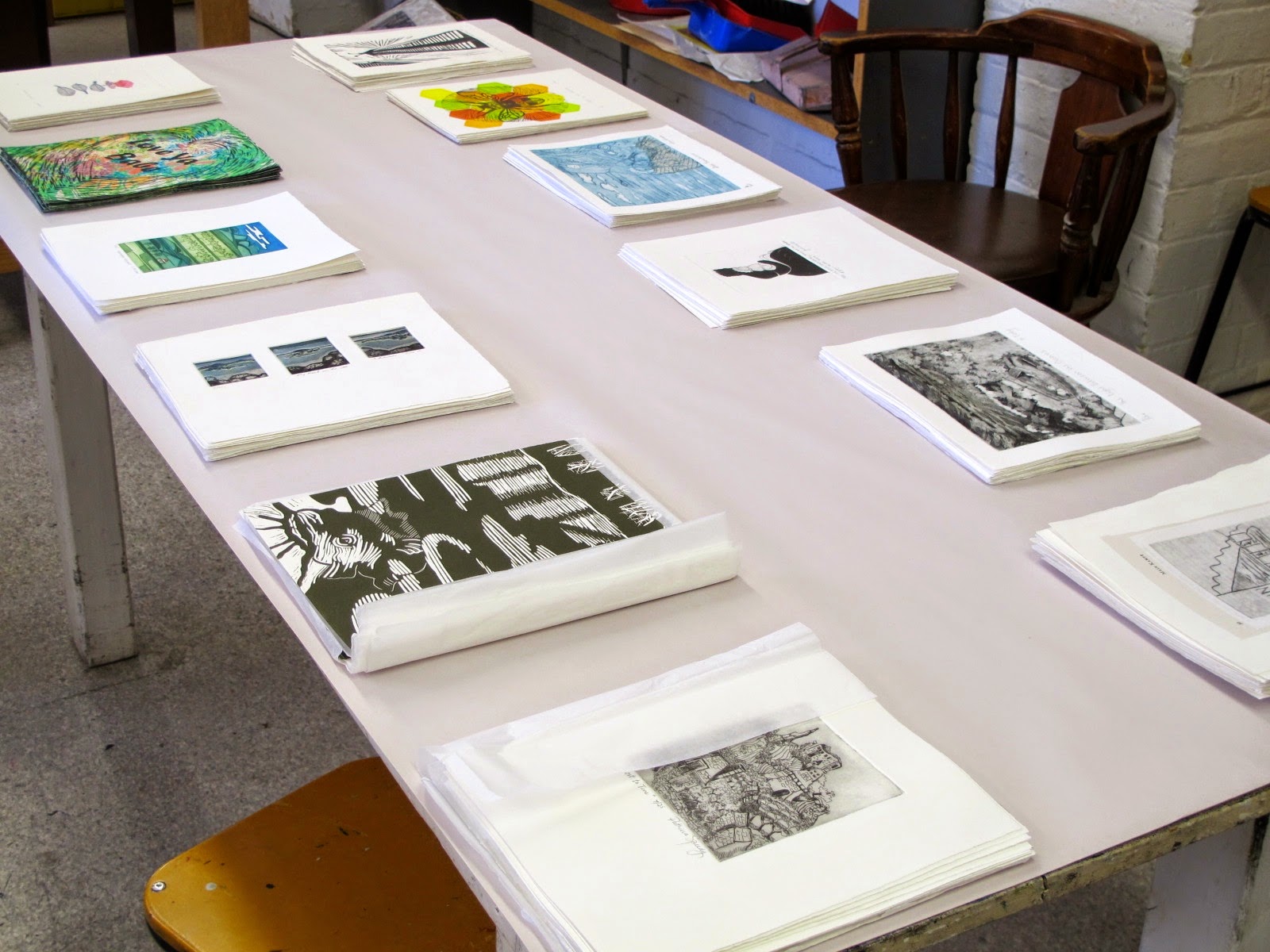
A little while ago several printmakers from the Waikato Society of Arts met to exchange prints. The idea was promoted and organised by Janice Meadows. Each printmaker was to create a print based on a poem or some prose of their own choosing. The arrangement was for the printmakers who were willing to participate to print enough prints to enable all the group to have one each. The organiser needed to have a one of each print for a set to be displayed at the WSA's Waiprint exhibition at ArtsPost in Hamilton. At the end of the lead-up time we all met to have morning tea and exchange prints. As usual with printmakers it was a social event full of bonhomie and cheer. Each printmaker presented their own work and explained the links between their print and the words that they had chosen. Quite educational. Here are a few photos from the event, taken in the WSA print room.
Some of the Prints

Printmakers

Carril Carr and Ruth Davey

Ruth Davey and Sarah Peers


Janice Meadows Displays Robin Cuff's Print

29 September 2014

William Peckover, one of Captain James Cook's men

William Peckover was a Royal Navy gunner. Peckover had a more interesting seagoing experience than most sailors. He sailed on all three of Captain James Cook's South Seas expeditions (1768-79) and was highly esteemed by Cook. He was fluent in Polynesian languages and after Cook's death was appointed to the crew of the Bounty. They reached Tahiti in October 1788, where Commander William Bligh put Peckover in charge of trading with the islanders. On April 28, 1789, during their return to England Peckover had been on watch from midnight to 4:00 am, and was asleep when Fletcher Christian took command of the ship. He was confined to his bunk during the mutiny, and not allowed on deck until Bligh and his supporters were being herded off the ship.

Artist Image of "Bounty" Mutuny

James Cook


He survived the 3500-mile journey to Timor and later testified in favour of Midshipman Peter Heywood at the 1792 Bounty court-martial. The last known naval reference to Peckover has him serving on the HMS Gelykheid in 1801. He served on ships during the American Revolution and the Napoleonic Wars. He is recorded as having served on the ships below, on each as a gunner.

30 Oct 1780 - HMS Dictator
15 Jul 1782 - HMS Resistance
11 Jun 1784 - HMS Recovery
16 Dec 1784 - HMS Warspite
27 Jan 1785 - HMS Amphitrite
24 Aug 1787 - HMS Bounty
01 Dec 1790 - HMS Antelope
06 Jun 1791 - HMS Sultan
23 Jan 1792 - HMS Antelope
06 Feb 1792 - HMS Ocean
23 May 1798 - HMS Bedford
30 Aug 1798 - HMS Irresistible
14 May 1801 - HMS Gelykheid

After 1801 there is no naval record of him.  However. I  recently discovered a family ancestral claim to him which has him born in the country (Aynho) in 1748 (this means he would have been 21 when he joined the navy) and dying at the age of 71 at Colchester. What tales this ancient mariner might have told!


Cook’s Man on the “Bounty”


Royal Navy gunner
old, powder-burned
you were the first
confined to your cabin
they didn’t dare ask you
to join their rebellion.

A mark of respect they said
after all, they venerated you,
three times with Cook
even their Captain was in awe
when he commanded you
who tongued the language
of the friendly islanders well,
to negotiate the breadfruit.

Floating halfway
across your Pacific
in the small boat
they often asked you,
William Peckover,
about your Man
their eyes flicking
towards the stern,

their Captain sitting there

writing to his beloved Betsy

bls

01 August 2014

Hard Scrabble


I've been at it again. This time I've collected together some of my poems from the last twenty years and put them out under the title "Hard Scrabble". Some have been published before. The collection has three sections, Urban Spread (places and people), Beyond the Roadends (mountains and valleys) and Beyond the Southern Shores (mainly antarctica and sub-antarctica). You can see a preview of the work at the following link.


  or you can go to Blurb.com and search under the title. Good luck.

It's available at Blurb as a soft cover for about US$12, or an ebook for about US$3

The hard cover with colour inside is more at US $18 but quite a nicely produced book (in my opinion)


The cover photo is of Catherine and Margaret heading up towards the summit of Urchin, one of our favourite day walks near Pukawa.

15 November 2013

Poetry Conference in New Zealand

Barbara Smith, Marion Baird, BLS,
Mere Taito and Jenny Fraser (l to r)

Five poets from Hamilton attended a national poetry conference (the first for a long time, if not ever) in Havelock North, near Hastings in the North Island (Te Ika a Maui or 'the fish of Maui') over the weekend of 2nd/ 3rd November 2013. The conference started on the Friday night with readings from the NZ Poet Laureate, Vincent O'Sullivan, followed by the first of four plenary sessions, each of 12 poets. Over the next two days the one hundred poets attended three more plenary sessions, two poetry group sessions and three panel discussions involving 'current approaches to getting poems published', 'form and content in contemporary poetry', and 'what editors are looking for'. And we all heard a great selection of excellent poems.


The conference was extremely well organised. Despite apprehension at the very full programme there were no heads seen to be nodding and the conference was marked by enthusiastic collegiality, intensity and humour.  The sessions were divided by five minute breaks at which everyone resumed their conversations from the last break! The venue also was good with room for attendees to get up from their chairs to talk, eat, drink and relax within seconds of the break being declared. Many were the friendships made and renewed.

I was lucky enough to be in the last plenary session, ably chaired by Maris O'Rourke.  The spirit of the conference was evident in the enthusiastic and copious exchange of emails between all of our participants. Well done Bill Sutton and your band of ready slaves : -) - and thanks from me.

Oh, and the Hamilton gang enjoyed their journey, one another's company - the whole caboodle.
Here's one of my poems:


WIND

I see you now, wind
bending branches
flowing across the slopes
of tussock

you make sounds
and when I hear you
at night, driving rain
against my window

the sound of you
through my aerial
reminds me of the moan
of you in rigging

you make sighs
on balmy days,
thunderclaps on ridges
what moves you, wind?

your absence
a lack of nodding
amongst flowers
part of that rare total hush

and you carry the must of earth
that tells the sailor at night
that he is nearly home
from the sea

you lift spume from waves
as I descend another trough,
cause spindrift between
waves of sastrugi

you flutter my flag
lick sweat from my brow
cause birds to fly
you are the very air I breathe

and I have learned
to hide from the chill
of your brisk southerly
embrace the warmth

of your nor-wester
relish your easterly
from the sea
wind.

I need you, wind
cool me, warm me
buffet me, feel me

wind.


18 December 2012

Kaiaua - Godwits - a Haibun


Today

Today seven hours of constant walking takes us down to the coast.  Leg weary we enter our bus to journey homewards to the south. The first town is Kaiaua.  After noting the rarity of its five consecutive vowel letters we note the three syllables and the meaning of its two words, food and herring. Situated between bush covered hills and the abundant waters of the firth, it appears delightfully well named.
Further down the coast is Miranda with its shallow mudflats. Here godwits and other waders gather close to the shore with each high tide under watchful eyes. We rejoice in the knowledge that our own species (for all its faults) gathers each year to toast, with sparkling wine, the departure of the godwits for their breeding grounds in Alaska and Siberia - and how each year when they return one southern city peals its bells in welcome. Such is our empathy.

Godwits (Koaka) and Other Waders - Miranda


tides push them to and from
the sun to and from
today it’s feeding time

A Godwit Peloton in Training - Miranda

29 November 2012

Camp Oven Bread

No one should ever go through life without having experienced bread made in a camp-oven – or better still having made camp-oven bread.  Here is what you do.

In an old blackened billy  put a couple of cups of  warm water (blood temperature), a couple of spoons of sugar, a little salt and some milk powder and a teaspoon or two of yeast.  Give it a slight stir and cover it with the lid in a warm place out of the wind.   In a large flat camp-oven place a pound or two of baking quality flour and allow to warm with the yeast.  When the yeast has well and truly started to work, mix it in with the flour and a little oil to make a firm, dough kneading it with the heel of your hand.  Place aside in the warm place and make a cuppa.

Catherine and Camp Oven Bread
After you have made the cuppa-tea, check that the dough has risen to about twice its volume.  Knock the last of your tea down and do the same with your dough.  While the dough is rising for the second time scratch out a shallow hole in the ground and light a good fire in the hole.  Don’t use big logs for this, only small to large sticks and plenty of them.  By the time the fire has died down but while the embers are still hot the dough should have risen.  Scratch the embers out to the edge of your hole and test the heat by holding an open hand over the area.  If your hand can’t be kept held at knee height above the embers they are too hot – wait a while.   Check that the dough has risen (you can make do with only one rise if you are hungry) and when all is well put the camp-oven into the hot hole.  With a shovel or spade or a tin plate cover the lid well with the embers from the side of the hole.  After about 25-40 minutes, depending on the size of the loaf, the heat of the fire, the smell emanating from the ground and your experience and judgement, you should push aside the expectant nose-twitching and slavering crowd and remove the oven from the ashes.

It might be expected that a large camp-oven would feed an average family for about two days.  I’ve never known a loaf to last more than about half an hour or take less than half a pound of butter.  Then they will all stand about asking when the next loaf will be due.  Just make sure you get your own share.


Bushman’s Bread

Work your dough
water, good flour, yeast
(the rest my secret)
rising, knocking it down
while the fire dies
scratch out embers, embed,
cover the camp oven lid
hunger grows from the ashes
fight back the slavering crowd
knock the loaf out
slice it thickly
watch the butter melt.

bls

26 October 2012

More on Food - Chocolate Doughnuts!

When we came down the Waimakariri we’d been short of food for a couple of days, it was cold and wet, we’d been going for two hours and hadn’t had any breakfast.  We stopped at Anti-Crow Hut to have a break from the weather and found, in a corner of the hut, an old camp oven half full of what seemed to be solid tallow or mutton fat.  A search of the hut, which seemed to have been vacated recently by hunters revealed a good quantity of flour, sugar, cocoa and some baking powder.  It didn’t take much imagination!  We had time up our sleeves and soon had a good fire going and the camp oven sitting on the embers.  While the fat melted and heated we set about the mixture.  As soon as the fat was hot enough we dropped our doughboys into the fat and watched them grow.  When they had developed a golden crust we fished them out with the No8 wire toaster and set them to drain on the hearth.  As soon as they had cooled enough we devoured them.  They were warm, chocolate sweet with enough satisfying fat and a warm golden colour on the outside.  They were more than satisfying.  Better than fish and chips!


Two Hours To Go


We trudge down valley
cold, wet and out of food
legs drag aching foot
after aching foot
hunger verging on weakness
gnaws deep beneath our ribs
we stop beside the hut
only two hours to go.

Anticrow Hut - 1950s
Inside is dry wood
a camp oven and fat
self raising flour
sugar and cocoa
and we have time
up our sleeves - yes
the last two hours
we do in one.

20 September 2012

Southern Light


The Light Under Tawa

Southern Light

Perception depends
on the angle of light
the way it might creep
under advancing clouds
(the sinister green of a cold front)
or through soft foliage
(the yellow green of tawa)
aesthetic light
seen after sunrise
or before sunset
when shadows are long
and valleys deep.

Antipodean Light - Enderby Island
It is best
beyond certain latitudes
say, Hebridean light
or antipodean light
over subantarctic herb fields;
light soft – better at high latitudes
where colours are muted
and sound softened.

bls

13 August 2012

Black Billy Brew

Ahhhh yes - the brew.  There are many moments that stand out in my memories from the hills. Cold morning starts, breaking clear of the bush onto open tops, the summit, discovering a cairn in the mist and good nosh are just some of them - all worthy of a blog or two.  But the back country brew, especially made over an open fire, ranks up there with the best.  Best of all using an old black billy. Here are a few writings, a photo and print images created to celebrate the brew.


Nostalgia
Nostalgia


About the billy rim
swirls beechwood smoke,
the surface rolls, receives
some bark and ash,
fist of tea
and time to brew

the handle-angled rim
spills steaming amber
into hungry mugs

all this and more
recalled today
in the aroma of clothes.


Canterbury Brew


      Canterbury Brew

      Once again
      on riverstone hearth
      flood whitened
      finger bones of trees
      feed hot flames
      about my black-skinned billy
      rolling to a boil
      in the smoke-blue air
      of an empty valley.


And finally a haibun, a Japanese form involving prose and, in this case, a haiku.


Alchemy

The time is right after a morning of packing up-valley and now you’ve found the perfect grassy flat between two tongues of bush – in sunlight.  You allow the pack straps to slide from your shoulders and feel the ease.   While she unpacks the billy and makes her way down to the water you gather together the makings of a fire, dried fern and grass, snappy twigs of beech with their brown leaves still attached and some larger water-worn dry sticks.  She returns with the water, pure as you expect it to be.  You arrange stones for the blackened billy. Soon the match flare and wisp of smoke becomes a fire.  Later you admire the glow of red embers and the movement of water and tea leaves within the billy. You shift the brew onto the edge of the ashes where it slowly rolls.

Alchemy
                                    Across the stream
                                    you observe trees
                                    collecting sunlight

So much alchemy, gold pouring from your billy.

30 May 2012

Poem Near the Beardmore Glacier

Here is a short poem that I wrote a couple of years ago.  I find it interesting for a couple of reasons.

Firstly it relates to a moment in 1959 in Antarctica when I sat on a ridge near the Beardmore Glacier and went digging in my pack for a bit of paper.  In the map pocket I found an old letter from a girl friend of some twelve or so months previously, one who'd been part of my life for about three years. As you do, you get over these things. Anyway I thought it appropriate to bury the letter and the past on the spot.

'Somewhere a Letter'    (Beardmore Gl. on left, Hood Gl. on right)
The other interesting thing about this poem is that it seems to work in most ways I re-order the lines. Not all ways, in fact with ten lines there are 362880 ways they can be ordered 10 factorial (or something like that) my maths friends tell me! Here is the poem, written in response to the recollection of that moment.


Cold Words

Somewhere
on a ridge
a cairn
known only to me
forever buried
under a pile of rocks
85 south
cold words
in blue ink, I recall
her last letter.

bls


21 January 2012

Behind Naseby

Behind Naseby is a wonderful 4WD route through the Oteake Conservation Park in the South Island hill country.  It takes you up the Manuherikia valley through open country, over the Little Omarama Saddle and brings you out at the southern end of the McKenzie Country.  On a fine day the views are extensive - the whole experience uplifting.  In dubious weather you could get stuck with your 4WD so go prepared!


Manuherikia Valley
Reclining Hills

Behind Naseby

In the valley are prickly places
A Prickly Place
         of thorn or sword
         briar, matagouri, speargrass,
         and of poets

of rabbits and hares
old stone walls
abandoned chimneys
and water races.

And soft above
where tussock bends
deferring to the breeze:
in the lay of the land

ridges, whole ranges
layered, laid back
reclining to the sky
a landscape to inhale.

Aoraki Mt Cook from Little Omarama Saddle

31 October 2011

Huts in the HIlls

There is something about huts in the hills. They are strategically placed for a break, often with a view, up or down a valley, looking at a leading ridge, to a peak or an upper beat.  They usually have water nearby, maybe a supply of beech for the fire or a seat outside to remove your boots.  Inside there may be a fireplace and always, and most importantly, some bunks to rest the body.  Sometimes they are high up (always a view here), cosy and here they have the extra advantage of having lightened your pack by the weight of a tent. If others are there the company is always good.

They all have a character of their own, the smoky chimney, the chopping block, their noises at night, their cladding, writing on the walls, even their loo. There are special things about huts in the hills in the way they talk to you, the clap or tap of tin or branches - the way they record the sound of wind and rain. It is always comforting and - secure.

Barker Hut - 1953
You always have your special huts - sometimes they are just memories - sometimes waiting your return - sometimes never to return.

Washbourne Hut

                                                So lonely, little in the big valley,
                                                hungry for talk.

                                                Scrub gone,
                                                only slack-wired
                                                remnants of a horseless paddock,
                                                the mound of chips,
                                                on top a well-chopped  log
                                                the axe.

                                                Inside your ruddy
                                                corrugated skin
                                                joints groan to the moan
                                                of the north-west wind,
                                                a silent patina remains
                                                of names that echo
                                                the clatters of cooks,
                                                talk of floods,
                                                snow raking 1918,
                                                the summer muster in '34.

                                                Mountain men with
                                                a big thirst for the Methven pub.

                                                A black billy sits upside
                                                down beside the bouldered hearth,
                                                a waratah skewers chimney sides,
                                                hangs empty hooks of No 8.

                                                Waxed stalactites droop from
                                                jam tin candle holders which
                                                hang on dwangs before
                                                your smoky walls.

                                                Tiered bunks sag,
                                                sacking, tattered, torn;
                                                where's one without a seam
                                                to rest the ghosts of passers through?